













Quick Summary
-
When a customer experience problem arises, businesses often fix the individual customer’s issue without addressing the underlying root cause.
-
Continuous CX improvement requires the discipline to not just fix for one, but to fix for all: Every complaint is an opportunity to both win over an aggrieved customer, and to make sure that same issue never affects any other customers.
-
The airline industry’s approach to researching and remedying the root cause of aircraft failures provides an excellent example for other industries to follow when handling CX failures.
Airlines are rarely held up as models of customer experience (CX) excellence, but in one important respect, the aviation industry actually deserves that recognition.
At many airlines, the traveler experience leaves a lot to be desired. People are subjected to a whole host of annoyances and indignities, from baggage charges to ticket change fees, from cramped seating to overbooking.
But one aspect of the airline customer experience is remarkably good, and consistently getting even better: The industry’s discipline in identifying and addressing the causes of accidents.
Say what you want about the awfulness of air travel, but it does have one undeniably redeeming quality: It’s really safe. While commercial airline accidents obviously garner a lot of media attention, the fact is, they are extremely rare. Accounting for just 0.003 deaths per hundred million miles flown, air travel is the safest form of transportation out there, far safer than driving (which, at 0.53 deaths per hundred million miles traveled, is 175 times more deadly).
How did commercial air travel get so safe? The answer was on display after the recent collision between an Air Canada jet and a fire truck at New York’s LaGuardia Airport. Within hours of the incident, the National Transportation Safety Board’s (NTSB) “Go Team” was mobilized, and it’s from their tireless work that all businesses can learn a valuable lesson.
Established in 1967, the NTSB is an independent government agency tasked with investigating all civil aviation accidents, as well as major incidents involving with other forms of transportation (such as train derailments).
The Go Team is a cornerstone of the NTSB’s investigative process. Ready to travel anywhere in the world at a moment’s notice, the Team is comprised of NTSB staff representing a variety of specialties – aircraft structure, engines, hydraulic systems, crew performance, and even air traffic control. They all descend upon the accident site to piece together what happened and to determine what went wrong.
Within a matter of days, the NTSB issues a preliminary report based on the Go Team’s findings. (An official, final report can take months if not years to publish, depending on the complexity of the incident.)
But here’s the most important part: Based on its investigation, the NTSB releases safety recommendations, some of which can then be turned into “Airworthiness Directives” by the Federal Aviation Administration (FAA). Those directives, which can be issued on an emergency basis if necessary, establish legally enforceable rules which can dictate anything from aircraft design changes (which would be handled by the manufacturer) to maintenance procedure enhancements (which would be handled by the airline). Even the FAA itself can be the target of the NTSB’s recommendations, in cases where the cause of an accident is traced to air traffic control or related operational issues.
What does that disciplined process of investigating aviation accidents and addressing their root causes yield? Decades of consistent improvement in the civil aviation fatality rate, with the trendline steadily declining over the past forty years, and recently hitting all-time lows. (The graph below shows commercial aviation fatality rates measured per million aircraft-miles flown — so it illustrates how, despite a significant increase in flights over the period, accidents became markedly less common.)
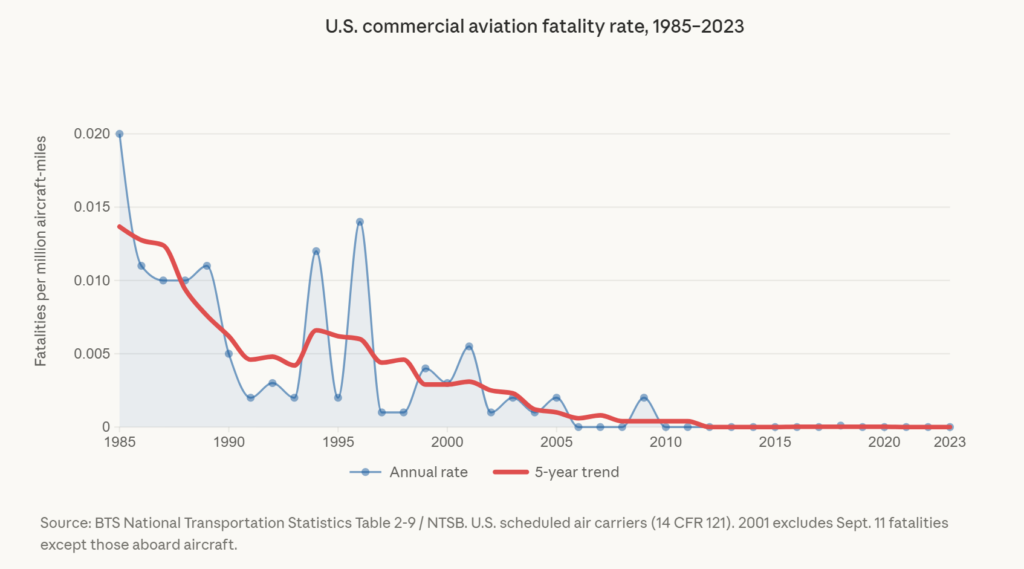
Now, imagine if the above graph were charting the failure rate for your company’s customer experience, perhaps measured through product defects, complaints or some other indication of an experience gone wrong.
Because that’s really what the NTSB Go Team (and other countries’ aviation safety agencies) do. They root out the underlying cause of a failure in the experience. Granted, in the case of the NTSB, they’re looking at failures that can be gravely serious, resulting in harm to dozens if not hundreds of passengers. But the value of the NTSB’s approach is applicable to any business, regardless of product or service sold.
Think of it this way: There are a finite number of reasons why an aircraft will suffer an operational failure. By rigorously investigating every failure, and directing its aviation partners to pursue remedial action, the NTSB and FAA have gradually narrowed the list of potential failure points. Hence the remarkable and steady long-term decline in accident rates.
The same logic applies to your business. There are a finite number of reasons why your company’s customer experience may fail, from a product design flaw to an outdated website link to an inaccurate instruction sheet. It may be a long list, but it is a finite list.
“There are a finite number of reasons why your company’s customer experience may fail… It may be a long list, but it is a finite list.”
You would be remiss then, if you didn’t take the opportunity to investigate failures when they occur, pinpoint the root cause, and take action to address the underlying issue. Only by doing so can you start to check items off of that finite list, and begin removing potential sources of experience failure from your customers’ lives.
To bring the NTSB’s proven approach to your organization, keep three things in mind:
- Invest in investigation. When experience failures arise, people’s focus is (rightfully) on solving the problem for the affected customer. Once that’s done though, typical organizational behavior is to just move onto the next task – answering the next call, resolving the next complaint, manufacturing the next widget. Resist that temptation. Culturally, people in your organization must understand that an essential part of experience recovery is asking yourself, “How did my customer even end up in this situation?”
- Turn insights into action. It doesn’t help anyone if a field sales rep or a call center agent figures out the root cause of a customer experience failure, but then doesn’t have an outlet to communicate that to people who can do something about it. After all, the NTSB’s investigations would be pointless without their safety recommendations and the FAA’s associated Airworthiness Directives. Make sure there is a clear avenue for your staff to share their root cause findings with those who can drive change in the organization, such as a manager or an internal continuous improvement team.
- Make it about progress, not punishment. Interestingly, conclusions from an NTSB investigation cannot be entered as evidence in a court of law. That was done by design, as the architects of the NTSB wanted the organization to be viewed as an independent party, focused on preventing future accidents, not facilitating litigation. In the business arena, staff need to be forthcoming in order to effectively assist with root cause analysis. If they sense that the exercise is a punitive one, they’ll likely be reluctant to participate in a genuine way. Keep it constructive, with an emphasis on learning from failures and facilitating continuous customer experience improvement.
Every company, even legendary ones, has to occasionally deal with customer experience failures. What separates the good from the great, though, is how the organization approaches the resolution of those issues. Does it fix the problem for just one customer, or does it address the problem for all customers in the future. The NTSB has certainly demonstrated its proficiency in the latter approach, chipping away at root causes and turning air travel into the safest transportation experience on the planet.
So, the next time your organization encounters a customer experience failure, ask yourself, “Who’s on our Go Team?” Whether it’s a responsibility that lies with a dedicated unit, or an accountability that’s embedded in every staff member’s role – ensure this investigative work consistently gets done, because it’s that discipline which will keep your business flying higher.
Jon Picoult is the founder of Watermark Consulting and author of the Wall Street Journal featured book, “From Impressed to Obsessed.” A former Fortune 100 executive, Princeton-trained in Cognitive Science, Jon helps global brands use the psychology of “memory sculpting” to drive ROI and turn customers into lifelong fans. Follow Jon on LinkedIn / Instagram, or subscribe to his monthly eNewsletter.